I recently watched Odyssey, and as a Hindu, I found a mountain of cultural resonance between ancient Greece & Bharat(India). From deities to ideology, and from swordsmanship to archery, here’s my perspective on why ancient Greek & Indian legends like the Mahabharata & Homer’s Iliad are more than just mythology. And how there is some lost ancient connection between Greece & India.
The Lost Links between Ancient Greece and India
I have a multi-layered, deep belief that all these legends are nothing less than the truth. Why? Let’s peel off this belief layer by layer.
What is truth?
First of all, how do you believe something is true? Well, either you have seen it with your own eyes, or it has been told to you by someone trustworthy. That trustworthy source can be a member of a family, a news channel, or a book by an authentic author. In this case, since those events happened thousands of years ago, there is no human alive(except Ashwathama) who has seen it with his own eyes.
Thence, there are only two sources of information. One, the verbal stories & knowledge that have been passed down the generations, one to another. The other source is the books or texts that have been written by various authors.
Since those books were written thousands of years ago, I believe that, over time, some parts may have been altered in reproduction by different people for different motives. But to claim that the whole work is fiction is a big claim.
To me, to check the authenticity of a text, especially an ancient one, there are two ways. First, compare it with similar texts of different cultures written at the same time. For example, when we compare the Mahabharat with Homer’s Iliad & The Persian Avesta, a lot of information about kingdoms, clan territories, and trade routes gets verified.
Second, India has the beauty of astrology. Indian astrology was so prosperous that there are various time-stamps about the position of the stars and planets in the Mahabharata & Ramayana. ‘Dating the Mahabharata’ is a documentary on YouTube that beautifully highlights this.
The Truth
To support my claim that Mahabharat and Homer’s Iliad are true events, and there is some linkage between ancient India & Greece, I will compare both texts.
Since, both texts were independently written by two different authors who by any means could not have influenced each other, the only way they can be similar is when they will be non-fictitious.
The Gods
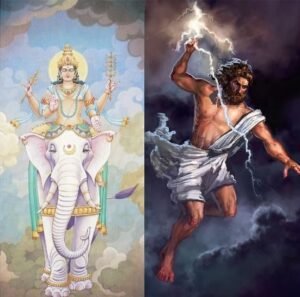
There is a striking similarity between the Hindu & Greek Gods. Though called by different names, the Hindus & Greeks worship Gods who share very similar characteristics. Moreover, both cultures have similar polytheism.
|
King of Gods / Sky
|
Zeus
|
Indra
|
Rulers of heaven (Olympus / Swarga), wielding thunderbolts (Keraunos / Vajra) and controlling weather and rain. |
|
Lord of the Underworld
|
Hades
|
Yama
|
Monarchs of the realm of the dead who judge human souls and enforce moral order. |
|
God of the Sea / Waters
|
Poseidon
|
Varuna
|
Divine rulers of oceans, rivers, and aquatic realms (Varuna also held sky/cosmic law duties in early Vedic tradition). |
|
God of Fire & Craft
|
Hephaestus
|
Agni / Vishwakarma
|
Agni acts as the sacred fire messenger; Vishwakarma mirrors Hephaestus as the divine architect and craftsman. |
|
God of War
|
Ares
|
Kartikeya (Skanda)
|
Supreme commanders of heavenly armies who embody battle, strength, and martial strategy. |
|
Divine Messenger
|
Hermes
|
Narada
|
Travelers across realms known for swift delivery of news, intellect, and occasional trickery. |
|
Goddess of Knowledge/Arts
|
Athena
|
Saraswati
|
Patron deities of wisdom, learning, music, and the arts. |
|
Dawn Goddess
|
Eos
|
Ushas
|
The Rituals
When I watched the Odyssey, there were many scenes that drew my attention due to cultural similarities with the Vedic people. There is a particular scene where Odysseus’s son Telemachus is ambushed by men trying to kill him at a temple. And I saw a earthern lamp(Diya) is lit in front of the deity.
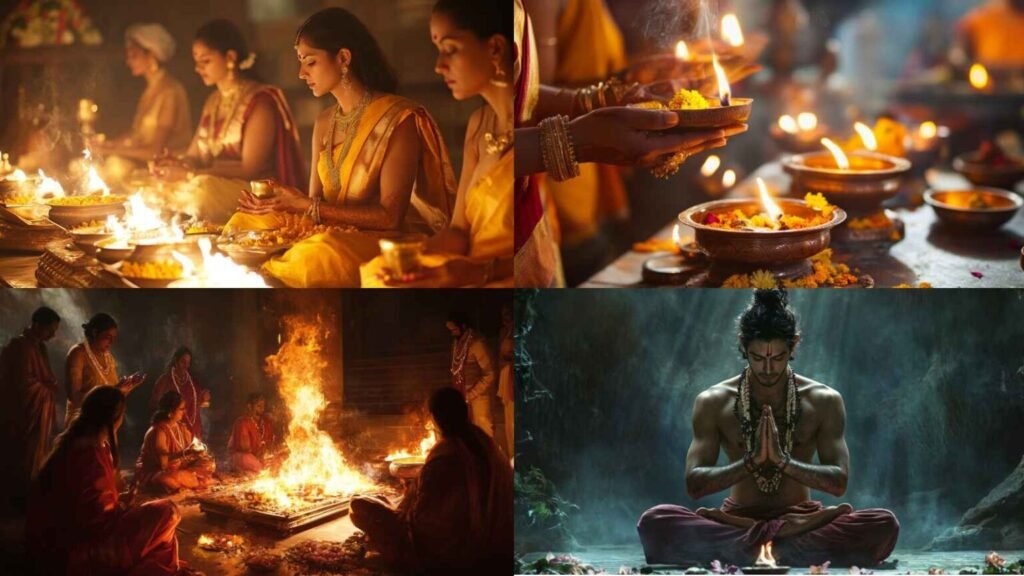
As a person who knew nothing about Greek culture, I found it quite interesting. When I researched the worship rituals of the Greeks, I found it very similar to those of the Vedic people. Here I have listed out some of them.
|
Ritual Element
|
Ancient Greek Practice
|
Hindu Practice
|
Shared Purpose
|
|
Fire as the Medium
|
Sacrifices offered on an outdoor altar (bomos); smoke carries offerings upward.
|
Offerings made into the sacred pit (Homa / Yajna); Agni acts as the messenger god.
|
Fire serves as the direct link between mortals and the heavens. |
|
Liquid Pouring
|
Libations (Sponde): Pouring wine, milk, honey, or water onto altars or ground.
|
Abhisheka / Tarpan: Pouring water, milk, honey, or ghee over murtis or ground.
|
Offering divine nourishment and showing reverence. |
|
Sacred Purity
|
Khernips: Ritual washing of hands and face with holy water before entering temples.
|
Snana / Shuddhi: Ritual bathing or washing of hands/feet before entering mandirs or performing puja.
|
Removing physical and spiritual pollution (miasma / ashaucha).
|
|
Incense & Sound
|
Burning frankincense/myrrh; chanting sacred hymns (Paeans).
|
Burning dhoop/agarbatti; chanting Vedic mantras and slokas. | Sanctifying the air and attracting divine attention through sound and scent. |
|
Deity Care & Dressing
|
Peplos ritual: Dressing idol statues (like Athena’s statue during Panathenaia).
|
Shringar: Daily ritual bathing, dressing, and ornamenting of idol deities (murtis).
|
Treating the idol as a living, hosted guest (Atithi).
|
|
Sacred Processions
|
Pompe: Festive street processions carrying sacred objects and statues to temples.
|
Yatra / Ratha Yatra: Processions carrying deity idols on chariots through towns.
|
Public communal celebration and localized blessing of land. |
Devi(Goddess)
The Odyssey has many scenes where goddess Athena appears in the form of a priestess who was killed by men of Odysseus. In India, it is strongly believed that if you are murdered or get killed at a very young age due to unnatural death, your soul does not pass on to further births for a very long time.
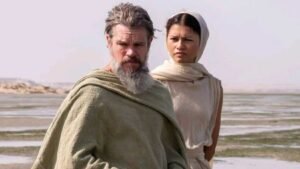
Moreover, in India there are many temples dedicated to forms of Devi(Goddess) who were once alive(a few hundred years ago) and got Sati(ancient Indian ritual where wife sacrifices her life if husband dies). My own Kula Devi (clan goddess) got Sati, and she is also a very active deity. The same is shown in the case of the priestess. She was very young & had a sudden death. In Jammu & Himachal(parts of India), there are hundreds of local deities who share a similar historical background.
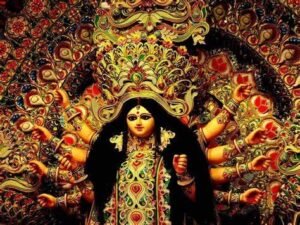
Odysseus in the whole movie is shown worshipping goddess Athena, who shares similarities with Goddess Tripura Sundari, one of ten prime deities accompanying Goddess Durga.
You will be surprised to know there are very few cultures that worship Goddess, and the Vedic & Greek cultures are among them.
Pretas (disembodied, ravenous spirits or “hungry ghosts”)
In the movie Odyssey, Odysseus travels to the edge of the Underworld at the river Oceanus in the misty land of the Cimmerians. Following the sorceress Circe’s instructions, he offers blood to all of his soldiers who died in war. Those soldiers then appeared before him, accepted his offerings & talked to him.
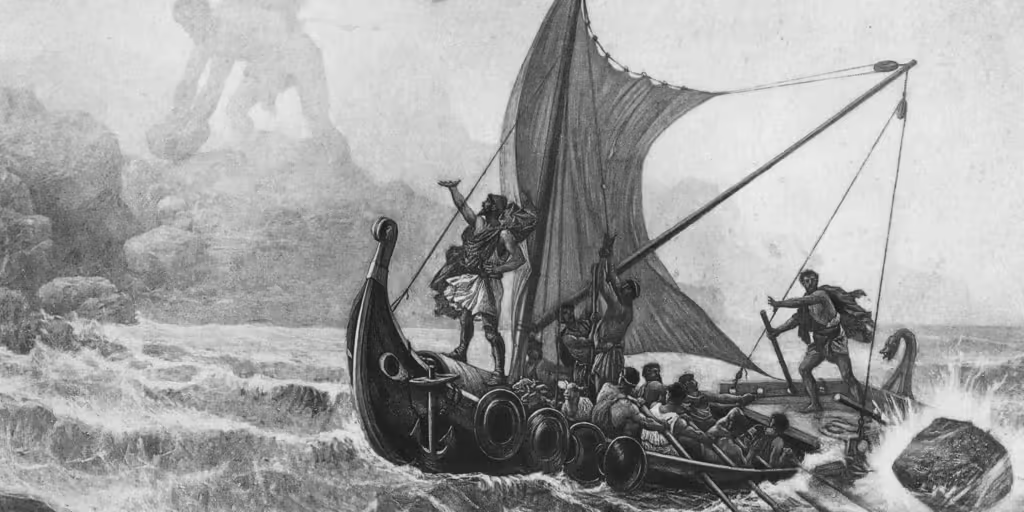
The Garuḍa Purāṇa (Preta Khaṇḍa) and the Padma Purāṇa (Pañcapretopākhyāna) provide some of the most detailed descriptions of the anatomy and dietary compulsions of Pretas. It is written that Pretas are forced by their nature to seek out raw, impure substances—specifically blood.
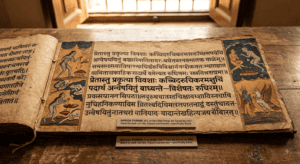
The tantric culture also verifies this. In the book ‘Aghora: At the left hand of God’ by Dr. Robert Sbovoda, there is a story of his guru Aghori Vimlananda who offered blood to pretas. You will find hundreds of similar examples.
Both ancient Greek and Indian seers had knowledge that is lost to the modern world.
The Giants
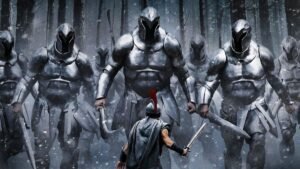
Mahabharata & Homer’s Iliad, both have mentioned giants. Various Hindu texts have highlighted that the size & intellect of humans will gradually decrease as the Yugas(time) will proceed. In moden day, we no more have giants, but various historic texts have mentioned giants.
Linguistic Similarity
The profound linguistic similarities between Sanskrit and Ancient Greek led 18th-century philologists like Sir William Jones to establish the Proto-Indo-European (PIE) language family. Both languages share cognate vocabulary, rich inflectional systems, and complex grammatical structures.
|
English
|
Ancient Greek
|
Vedic / Classical Sanskrit
|
Proto-Indo-European Root
|
|
Father
|
Patēr (πατήρ) | Pitṛ (पितृ) |
*ph₂tḗr
|
|
Mother
|
Mētēr (μήτηρ) | Mātṛ (मातृ) |
*méh₂tēr
|
|
Brother
|
Phrātēr (φράτηρ) | Bhrātṛ (भ्रातृ) |
*bhrā́tēr
|
|
Name
|
Onoma (ὄνομα) | Nāma (नाम) |
*nómn̥
|
|
God / Sky
|
Zeus (Ζεύς) | Dyaus (द्यौस्) |
*dyēws
|
|
Three
|
Treis (τρεῖς) | Trayas (त्रयस्) |
*tréyes
|
|
Seven
|
Hepta (ἑπτά) | Sapta (सप्त) |
*septḿ̥
|
|
Mind / Spirit
|
Menos (μένος) | Manas (मनस्) |
*ménos
|
Art & Craftsmanship
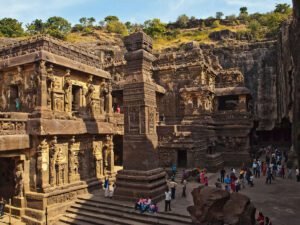
Both ancient Vedic and Greek civilizations were very advanced in art, architecture, and craftsmanship (Shilpa). Their temples are the best example of this. Rather than relying on random inspiration, both cultures integrated science, philosophy, and practical technique to shape enduring aesthetic standards.
Indians & Greeks – Children of one father?
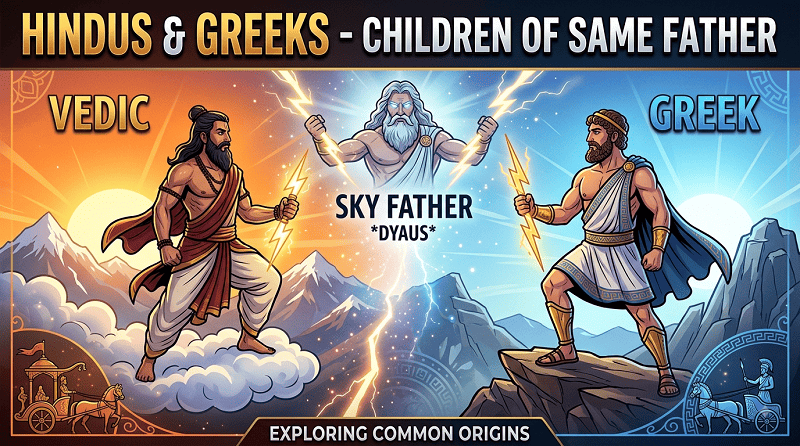
It is believed by modern historians that around 4000 to 3000 BCE, a group of pastoral nomads known as the Proto-Indo-Europeans lived in the Pontic-Caspian steppe (modern-day southern Russia and Ukraine). As this population expanded, different tribes migrated in various directions—one group moved southwest into the Mediterranean basin (eventually becoming the Mycenaeans and Greeks), while another migrated southeast into Iran and the Indian subcontinent (becoming the Indo-Iranians and Vedic Indo-Aryans).
Final Words
Our Vedas, Puranas, and epics like the Mahabharata & Ramayana are more than just works of fiction. There are very deep scientific secrets and a knowledge that is undecipherable to the modern world in its true nature.
It is believed by modern geneticists, studying ancient DNA, that the human population has expanded from a very small one(around 1280). Indians have also believed in Gotra(a clan). It’s believed we all are descendants of sapt-rishis(7 sages).
Mahabharata and Homer’s Iliad highlight two very similar cultures. Though adulterated over time, I believe they are not works of fiction; they are our historical records. They are one of those precious texts that make us proud of our roots, our ancestors, our culture, and the great beings who once lived among us & now worshiped as God.
References
- Dating the Mahabharata – A documentary
- Mahabharata – History, Story & Facts by Britannica
- Iliad by Homer – Wikipedia
- Sanskrit – World History Encyclopedia
Authored By: Nik
Hi, Nik is my public name as an author. I’m an active soldier in the Indian Airforce. Between duties & Sadhana I try to squeeze out time for my passion, that is blogging. I’d love to hear from you, your feedback on my article. If you would like to connect with me, follow my Telegram & Whatsapp Channel.